

More Blog Posts
Villa Digital
Engineering AG
Tittwiesenstrasse 21
7000 Chur
Alte Landstrasse 248
8708 Männedorf
Zugerstrasse 53
6340 Baar
Neugasse 12
9000 St. Gallen
Digitizing Historic Architecture Cost-Effectively
315 laser scans, 160 GB of point cloud data, and 280 hours of modeling: How VDE created a digital baseline for the University of Zurich to plan the renovation and long-term documentation of a historic landmark.
When we talk about BIM, digital twins, and laser scanning today, many people first think of new construction or modern office buildings. Yet historic structures in particular benefit greatly from a precise digital as-built survey. We had the privilege of carrying out one of our most exciting projects in this field for the University of Zurich.
A Building Steeped in History
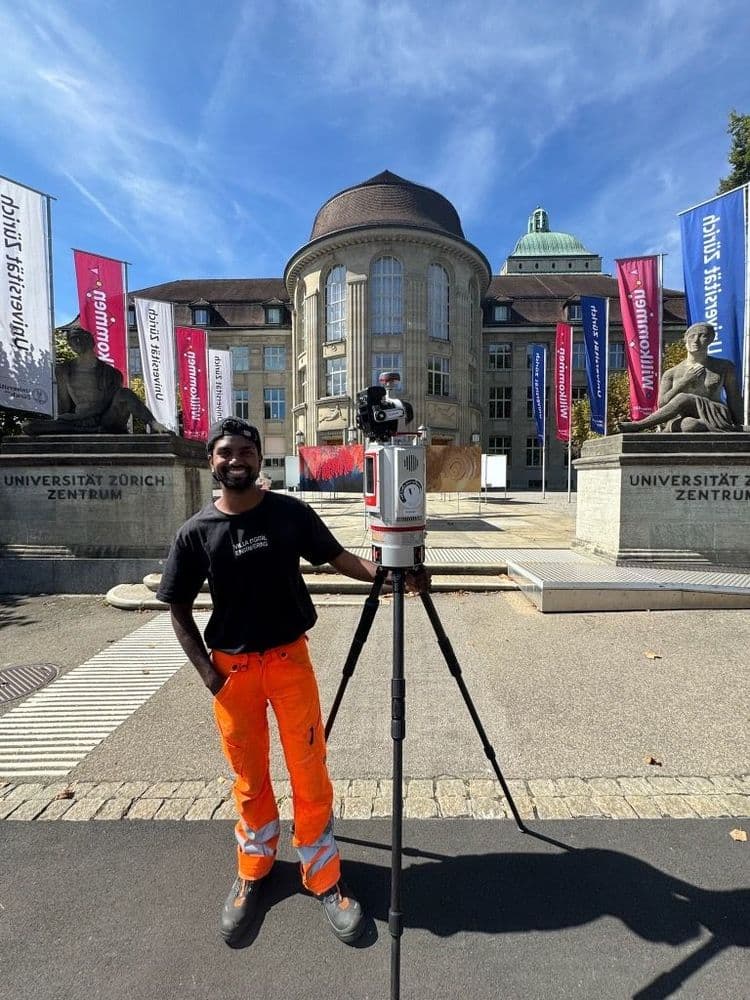
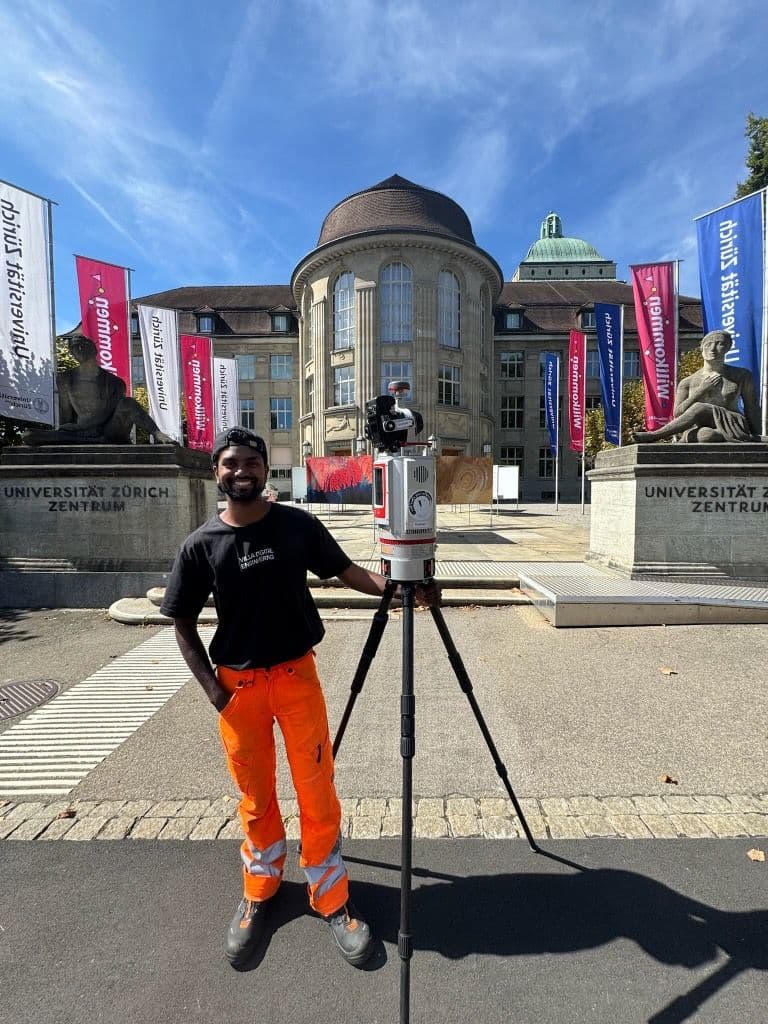
The main building of the University of Zurich was constructed between 1909 and 1914 according to the plans of the renowned architect Karl Moser. To this day, it remains one of Switzerland’s most famous university buildings and plays a significant role in shaping Zurich’s cityscape. For a planned renovation and long-term preservation documentation, the atrium—including part of the entrance area—was to be digitally captured and processed into a precise 3D as-built model. It became clear during the very first visit that this was no ordinary as-built survey project. The monumental architecture, the historic ornamentation, and the impressive interior sculptures make the building a truly special place.
Why the University of Zurich Chose VDE
Various providers were evaluated for the project. The decisive factors in awarding the contract to VDE were our experience with complex as-built surveys and our specialization in detailed, deformation-accurate building models. We had previously had the opportunity to carry out various projects for the Building Authority and the Canton of Zurich. These experiences built trust and demonstrated that we can digitize even challenging historic buildings cost-effectively and with precision.
315 scanning positions in just one Saturday
The survey could only be conducted outside of regular university hours. During lecture periods, the building is bustling with activity, which would have made complete data collection virtually impossible. Therefore, the entire survey was carried out over a single weekend.
Project Key Figures
• Property: University of Zurich, Main Building
• Location: Rämistrasse 71, Zurich
• Year built: 1914
• Project area: Atrium and part of the entrance area
• Modeled area: 4,655 m²
• 315 scanning positions
• 2 surveyors on site
• 2 RIEGL VZ-400i laser scanners
• 1 day of scanning
• 18 hours of surveying
• Approximately 160 GB of point cloud data
• Accuracy: ± 2 cm
• Deformation-compensated modeling
A complete digital survey of the project area was created in a single day. Without modern 3D laser scanning, documentation of this quality and comprehensiveness would have been virtually impossible.
The real challenge began only after the survey
was completed It is often assumed that data collection is the most difficult part of a project. At the University of Zurich, however, this was not the case. The biggest challenge lay in the modeling. The historic atrium contains numerous architectural details, ornamentation, plaques, and sculptures. In total, between 10 and 20 art-historically significant elements had to be integrated into the digital model as faithfully as possible. The traditional approach would have been to recreate all details as CAD geometry. Technically, this would have been possible, but it would hardly have made economic sense. This is precisely where the crucial question arose: How can a historic building be digitized as faithfully as possible without causing the effort and costs to skyrocket?
BIM Meets Mesh Technology
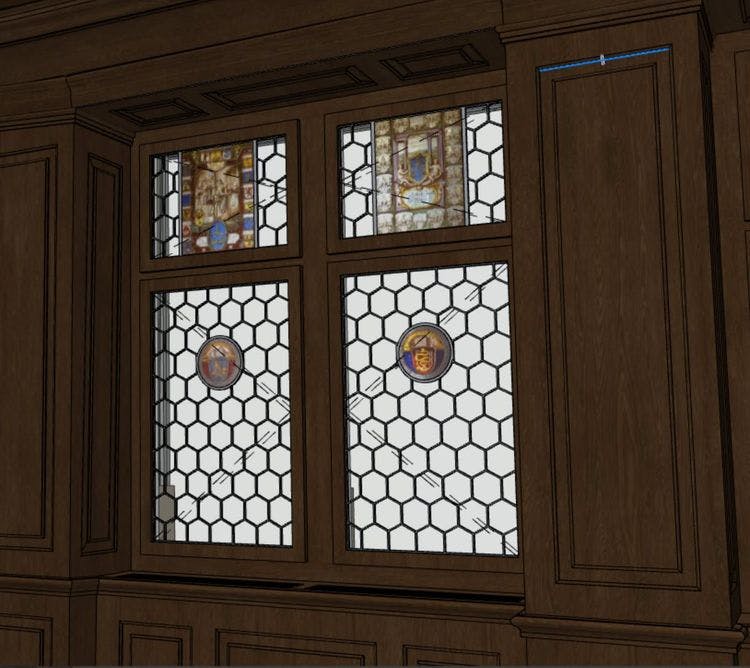
After an initial analysis of the point cloud, our team opted for a hybrid approach. All components relevant to the design—such as walls, ceilings, columns, and other building elements—were precisely modeled in ArchiCAD. The historical sculptures, plaques, and ornamentation, on the other hand, were imported directly from the point cloud as mesh objects.
This decision offered several advantages:
Maximum Accuracy
The historical details could be reproduced almost exactly as they appear in reality.
Cost-Effective Implementation
Fully modeling all ornamentation in CAD would have significantly increased the workload.
Faster processing
Mesh technology significantly reduced the modeling effort.
Authentic representation
Instead of a simplified interpretation, the result was a digital representation that closely resembles the original. It was precisely this aspect that made the project particularly exciting for me personally. We had already used similar approaches on smaller projects. But this was the first time we were able to apply this method to such a well-known and architecturally significant building. The impressive courtyard with its historic figures vividly demonstrated the potential of combining BIM and mesh technology.
280 Hours of Modeling Work
Once the survey was complete, the actual analysis began. Four experienced modelers worked a total of approximately 280 hours to create the digital as-built model.
The results included: • 2,708 modeled elements • Georeferenced 3D as-built model • Compliant with historic preservation drawing standards • ArchiCAD 28 model • Delivered as PLN and PLA files
The finished model accurately represents the existing structure, accounting for any deformation, and provides a reliable foundation for future planning and renovation work.
More Than Just a BIM Model
For the client, the result was far more thanjustan ordinary 3D model. In addition to providing direct support for the renovation planning, the University of Zurich also received long-term digital documentation of the historic building. This aspect is becoming increasingly important, especially for historic buildings. Structures change over decades. Precise digital documentation helps to permanently preserve historic structures and make them accessible to future generations.
What We Learned from This Project
The project has shown us once again that the best solution is not always the most elaborate one. Especially in historic preservation, the goal is not to model every detail in the most complicated way possible. What matters most is striking the right balance between accuracy, cost-effectiveness, and the actual benefit to the client. The combination of laser scanning, BIM modeling, and mesh technology made this balance possible.
** The results speak for themselves**
The project was successfully completed and met all requirements for renovation planning and historic preservation documentation. We are particularly pleased that this successful collaboration did not end with this project. Subsequently, VDE was commissioned to carry out further projects for the University of Zurich. For us, this is the greatest validation of our work: when a challenging task gives rise to a long-term partnership.
Are you planning a historic preservation or renovation project?
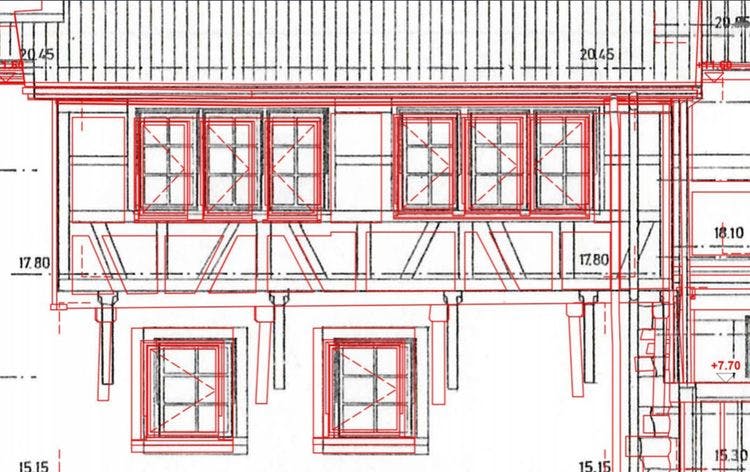
VDE supports architects, planners, historic preservationists, and building owners in the digital documentation of historic buildings. Our services include: • 3D laser scanning • Building surveying • Scan-to-BIM • ArchiCAD and Revit models • Historic preservation documentation • Point cloud processing • Digital twins • 2D and 3D as-built plans
Are you looking to digitize historic architecture precisely and cost-effectively? Then we look forward to hearing from you.